

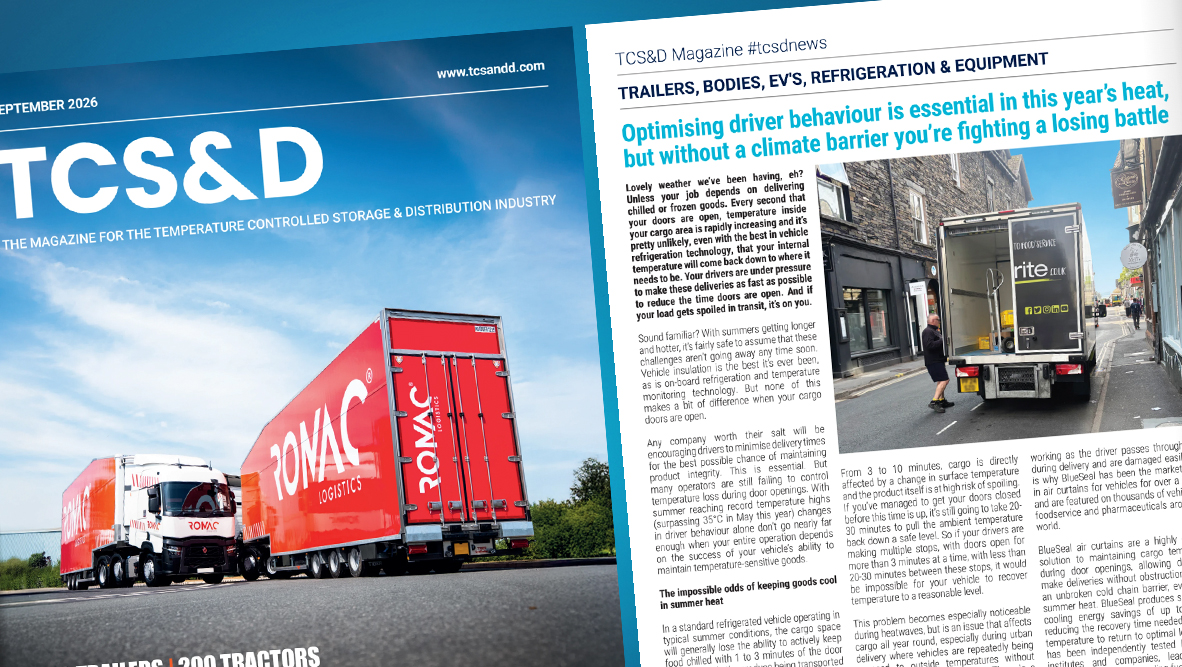
Optimising driver behaviour is essential in this year’s heat, but without a climate barrier you’re fighting a losing battle.
Lovely weather we’ve been having, eh? Unless your job depends on delivering chilled or frozen goods. Every second that your doors are open, temperature inside your cargo area is rapidly increasing and it’s pretty unlikely, even with the best in vehicle refrigeration technology, that your internal temperature will come back down to where it needs to be. Your drivers are under pressure to make these deliveries as fast as possible to reduce the time doors are open. And if your load gets spoiled in transit, it’s on you.
Sound familiar? With summers getting longer and hotter, it’s fairly safe to assume that these challenges aren’t going away any time soon. Vehicle insulation is the best it’s ever been, as is on-board refrigeration and temperature monitoring technology. But none of this makes a bit of difference when your cargo doors are open.
Any company worth their salt will be encouraging drivers to minimise delivery times for the best possible chance of maintaining product integrity. This is essential. But many operators are still failing to control temperature loss during door openings. With summer reaching record temperature highs (surpassing 35°C in May this year) changes in driver behaviour alone don’t go nearly far enough when your entire operation depends on the success of your vehicle’s ability to maintain temperature-sensitive goods.
The impossible odds of keeping goods cool in summer heat
In a standard refrigerated vehicle operating in typical summer conditions, the cargo space will generally lose the ability to actively keep food chilled with 1 to 3 minutes of the door opening. While the produce being transported has a different thermal mass, so will spoil more slowly, it is still a race against time as the environment inside the vehicle is almost immediately compromised the moment that doors open.
This is because of the density of hot and cold air. Without a climate barrier, cold (dense) air spills out of the bottom of the cargo area like flowing water, and hot, humid air rushes in through the top of the door opening. Even if a refrigeration unit were to stay on during a door opening (and it shouldn’t be), it would be physically impossible to cool the incoming warm and humid air fast enough to offset this temperature increase.
From 3 to 10 minutes, cargo is directly affected by a change in surface temperature and the product itself is at high risk of spoiling. If you’ve managed to get your doors closed before this time is up, it’s still going to take 20-30 minutes to pull the ambient temperature back down a safe level. So if your drivers are making multiple stops, with doors open for more than 3 minutes at a time, with less than 20-30 minutes between these stops, it would be impossible for your vehicle to recover temperature to a reasonable level.
This problem becomes especially noticeable during heatwaves, but is an issue that affects cargo all year round, especially during urban delivery where vehicles are repeatedly being exposed to outside temperatures without time to recover between stops. There is a very clear limit to how many deliveries a refrigerated vehicle can reasonably make when internal temperatures incrementally rise over the course of a delivery run. But you can greatly mitigate this through use a climate barrier.
A tried and tested solution to keeping goods cool
Installing a climate barrier in your vehicle is no longer an optional extra. But PVC curtains are almost universally disliked by drivers – they create an unwanted obstruction, stop working as the driver passes through them during delivery and are damaged easily. This is why BlueSeal has been the market leader in air curtains for vehicles for over a decade and are featured on thousands of vehicles for foodservice and pharmaceuticals around the world.
BlueSeal air curtains are a highly effective solution to maintaining cargo temperature during door openings, allowing drivers to make deliveries without obstruction through an unbroken cold chain barrier, even in the summer heat. BlueSeal produces substantial cooling energy savings of up to 45% by reducing the recovery time needed for cargo temperature to return to optimal levels. This has been independently tested by various institutes and companies, leading to a noticeable reduction in cooling fuel costs and greatly improved product preservation.
If you are struggling to keep your load cool in this year and you feel like you’re fighting a losing battle against the elements, BlueSeal air curtains may very well be the solution you’re looking for.
This article was originally published in TCS&D Magazine – September 2026. You can read the original article on page 24 at https://online.pubhtml5.com/culdp/unvb/
For more information on BlueSeal air curtains, please contact our Brightec consultants at [email protected]