

BlueSeal air curtains reduce air infiltration into the cargo space by 90% in a 13.6 metre semi-trailer
When the doors of a vehicle are opened during deliveries, refrigerated air escapes and warm, outside air enters the cargo space. The problem becomes compounded over multiple stops, which is especially prevalent in last-mile delivery and urban distribution. BlueSeal air curtains have helped solve this problem for thousands of temperature-controlled vehicle operators worldwide.
According to research by CENEX UK, this air infiltration accounts for about 70% of a refrigeration unit’s total thermal load. As doors open, heavy cold air cascades out of the bottom of the doorway like a waterfall, and warm and humid air rushes in through the top of the doorway.
In collaboration with a French semi-trailer manufacturer, we tested how effectively BlueSeal manages this exchange and the time it takes for this process to occur once a door has opened.
The results delivered an impressive 90% reduction in infiltration rate in a 13.6 metre semi-trailer.
The test method: using CO2 as an accurate tracer
Because the walls of the vehicle and the cargo it’s transporting have significant thermal mass and influence on the measurable air temperature, we used carbon dioxide (CO2) as a tracer gas to directly and objectively capture the true dynamics of air exchange.
The cargo space of a refrigerated trailer was injected with CO2 to an initial concentration of approximately 5000 ppm, which served as the 100% baseline, with the gas spreading homogeneously throughout the cargo space. At time t = 0, the rear doors were fully opened and the decay of the concentration was recorded every 15 seconds for over 13 minutes. Testing was conducted inside a production hall with a temperature of 23 °C, under two different conditions:
- Chilled (+3 °C) without BlueSeal (open doorway, unprotected)
- Chilled (+3 °C) with BlueSeal air curtain (open doorway, protected by BlueSeal)
The results: free fall versus controlled retention
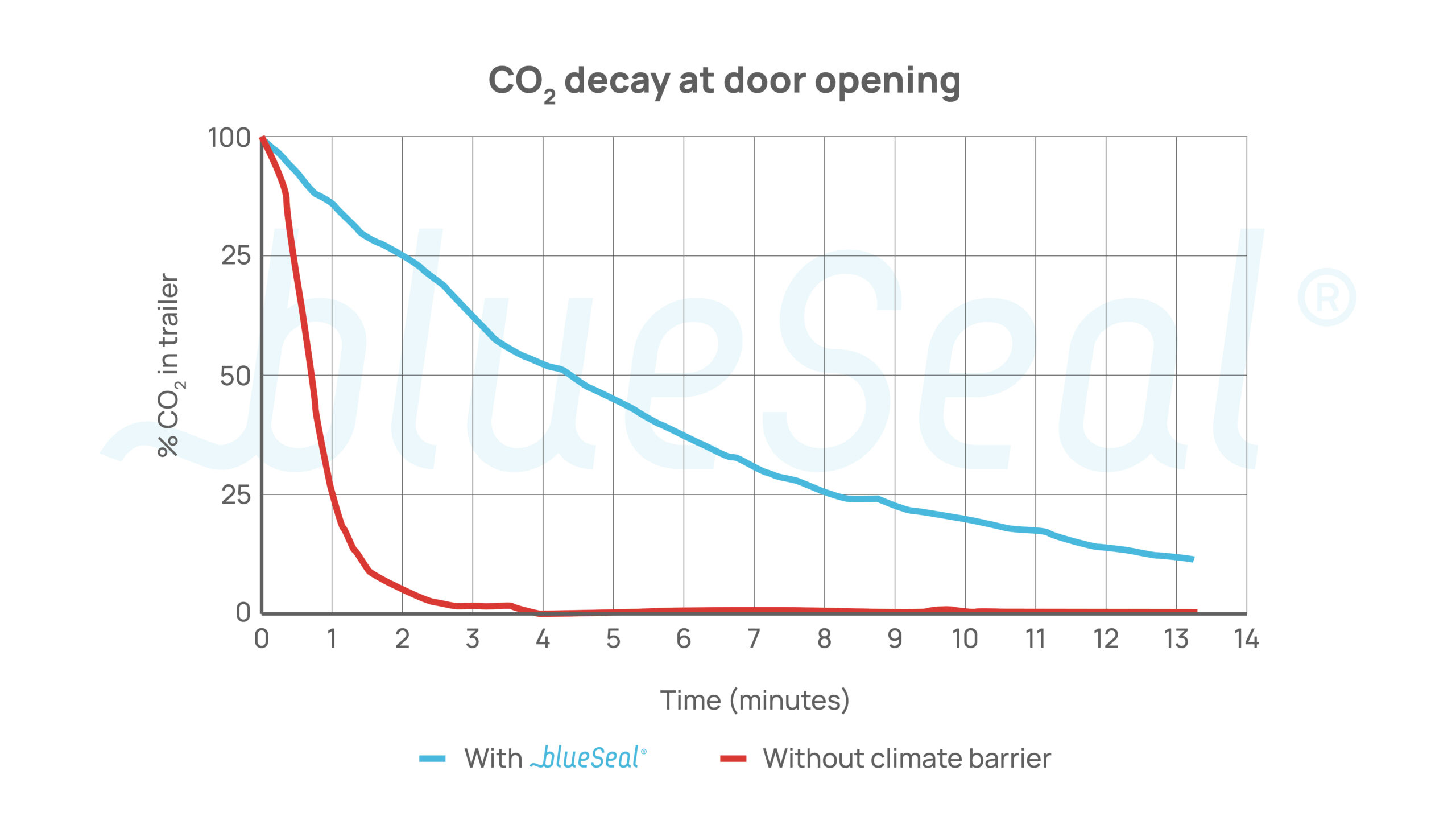
As we can see, there is a strikingly large difference between an unprotected doorway and one fitted with BlueSeal air curtains.
- Without BlueSeal (+3 °C): Virtually empty within two minutes
Without a barrier, the concentration plummets immediately. Within 40 seconds, half of the conditioned air is gone (the half life t50% = 0.67 minutes). After 1 minute, only 24.2% of the gas remains, and after 2 minutes, 94.7% of the original indoor air has already been replaced by outdoor air. After 4 minutes, there is no measurable trace of CO2 left. The infiltration rate here is k ≈ 1.5 to 1.6 min-1 (over 90 Air Changes per Hour).
- With BlueSeal (+3 °C): 90% reduction in infiltration
As soon as the BlueSeal air curtain is active, the decay curve dramatically flattens to a stable infiltration rate of k ≈ 0.15 to 0.16 min-1 (only about 9 Air Changes per Hour). After 1 minute, 86.0% of the gas is still in the vehicle. After 2 minutes, this is still 75.6%. Even after 5 minutes of door opening, almost half of the conditioned air is preserved. The half-life increases to 4.40 minutes, a delay by a factor of 6.6.
This results in a calculated reduction of the infiltration rate of about 90%. An average delivery in an urban environment is around 1 to 3 minutes, so we can clearly see how effectively BlueSeal maintains the vast majority of the conditioned climate.
How vehicle size affects infiltration rates
While this test was conducted in a 13.6 metre semi-trailer, these results are significantly more pronounced in rigid trucks and smaller delivery vans where BlueSeal is commonly used. This is because the volumetric rate of air influx through an open rear door depends on the dimensions of the doorway (particularly door height) and the temperature difference between inside and outside air, rather than the length of the vehicle.
For example, a rigid truck has a rear doorway only slightly smaller than that of a semi-trailer, but often less than half the cargo volume, so the incoming air displaces the conditioned climate much faster. Consequently, the Air Changes per Hour (ACH) in a rigid truck are nearly twice as high.
In light commercial vehicles (delivery vans), this phenomenon is even more pronounced. While a van’s smaller doorway reduces the absolute volume of incoming air to about 25–30% of a trailer’s influx, its internal cargo volume is proportionately far smaller (typically just 10–14% of a semi-trailer).
As a result, the ACH in a delivery van can be up to 2.5 times higher than in a full-sized trailer. Without a BlueSeal air curtain, a rigid truck can lose its entire conditioned air volume in under a minute, while a delivery van loses half of its cold air in 15 to 20 seconds.
What this means in practice
For transport operators and fleet managers, these results demonstrate a clear operational advantage to installing BlueSeal in their vehicles.
- Strict temperature control (GDP & HACCP)
By retaining up to three-quarters of the conditioned air during a typical delivery stop, BlueSeal helps to keep the core temperature stable inside the cargo area. This means that product integrity is maintained through more stable temperatures, keeping perishable cargo considerably less vulnerable to spoilage.
- Reduced refrigeration load and energy savings
Because the cooling unit of the vehicle (TRU) no longer has to continuously recover a full cargo space of warm, humid ambient air, less energy is required to achieve this. This means that your TRU requires less fuel consumption (or battery range in electric vehicles) and the lifespan of your TRU is extended through a reduction in mechanical wear. For further results on cooling energy savings, read more about how the Centre for Sustainable Energy Use in Food Chains (Brunel University) achieved up to 45% reduction in cooling energy in their 18-tonne truck model.
- Minimised evaporator icing
A byproduct of outside air entering the cargo space is the significant amount of moisture it carries in. By reducing this infiltration by 90%, ice build up on the evaporator coil is drastically curtailed, resulting in fewer necessary defrost cycles and sustained cooling performance.
The impact that BlueSeal air curtains have on the ability of a temperature-controlled vehicle to maintain product temperature cannot be understated. By reducing the infiltration rate by 90%, goods are considerably better preserved over multiple delivery stops and the energy required for a vehicle to recover cargo temperature is dramatically reduced.
And in addition to its ability to protect cargo from temperature fluctuation, BlueSeal manages to achieve this in a way that is far more convenient for drivers making deliveries, by offering an invisible and effective barrier for them to enter and exit the cargo space without obstruction.
While these results speak for themselves, we know that the real proof is how BlueSeal air curtains perform on the road. So if you’re still on the fence about enhanced climate control in your vehicles, why not ask one of our customers how their operation has been improved since installing this technology?
For more information on BlueSeal air curtains, please contact our Brightec consultants at [email protected]